You Don't Have An AI Problem. You Have A Process Problem.
I know that's not what anyone wants to hear. AI is exciting. Process mapping is not. But the data keeps saying the same thing, and it's worth paying attention to.
A recent survey of over 1,600 global business leaders found something that should stop every executive mid-purchase order. 85% of companies say they want fully autonomous AI workflows within three years. But 76% of those same leaders admit their operations aren't ready to support it.
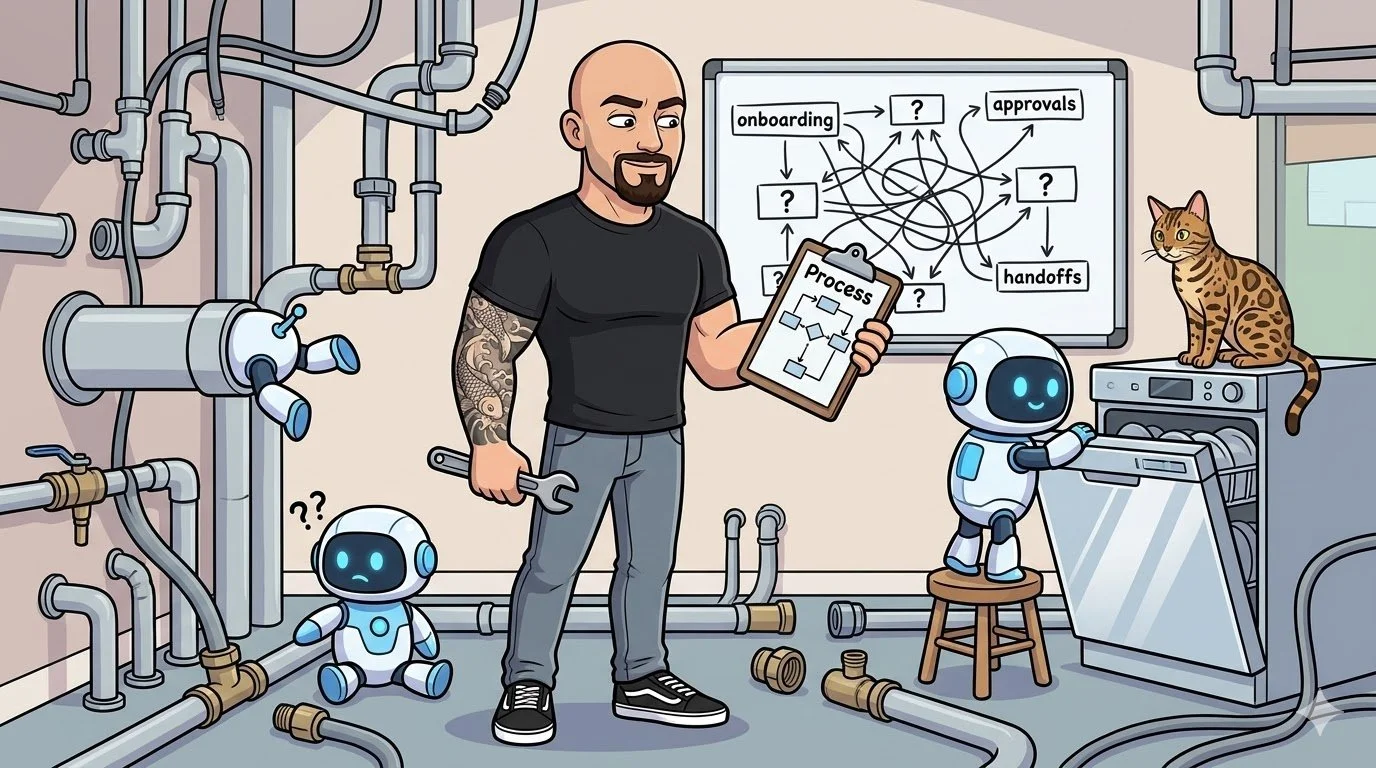
Read that again. Three out of four companies are buying AI tools for a house that doesn't have plumbing yet.
This isn't a fringe finding. MIT research showed that 95% of enterprise AI projects failed to deliver measurable financial returns within six months. Not because the AI didn't work. Because it was dropped into workflows that were already broken.
Think about it like this. You wouldn't install a high-end dishwasher in a kitchen with no running water. But that's basically what's happening across thousands of companies right now. They're spending millions on AI and layering it on top of processes that haven't been examined in years.
The mess underneath
At Spark6, we see this constantly. A company comes to us wanting to "add AI" to their customer onboarding. So we ask a simple question: walk us through the current onboarding process, step by step.
And that's where it falls apart. Nobody can. Three departments are involved. There are handoffs happening over email, Slack, and sometimes a sticky note on someone's monitor. Half the steps exist because someone built a workaround in 2019 and it just stuck.
You can't automate what you can't describe. And most companies can't clearly describe how their own work actually gets done.
This is the real reason AI pilots stall. It's not a technology gap. It's a visibility gap. Leaders are making AI investment decisions without an accurate picture of how their operations actually run.
What to do about it this week
You don't need a six-month consulting engagement to start fixing this. Here are four things you can do in the next five business days.
Pick one process. Not your most complex one. Pick something mid-level that touches two or three teams. Customer onboarding, invoice approval, lead routing - something like that.
Map it as it actually works. Not the org chart version. Not the version in the SOP document from 2021. Sit with the people who do the work and ask them what actually happens. Where do things get stuck? Where do they build workarounds? You'll find the real process looks nothing like the official one.
Find the human bottlenecks. Look for the spots where someone is manually copying data between systems, making a judgment call that could be standardized, or waiting on an approval that doesn't need to exist. These are your actual AI opportunities - not the ones the vendor is pitching you.
Ask the vendor question backwards. Instead of asking "what can this AI tool do for us," ask "what would our process need to look like for any AI tool to actually work here?" If you can't answer that clearly, you're not ready to buy. You're ready to clean.
The unsexy competitive advantage
Here's what the companies getting real ROI from AI have in common. It's not better technology. It's not bigger budgets. It's that they did the boring work first.
They mapped their processes. They fixed the broken handoffs. They standardized the things that should be standard. Then they brought in AI - and it worked, because it had something clean to plug into.
The executives I talk to who are most frustrated with AI are almost always the ones who skipped this step. They bought the tool before they understood the workflow. And now they're three quarters into a pilot that's going nowhere, wondering if AI is overhyped.
It's not overhyped. It's under-prepared for.
The companies that win with AI in 2026 won't be the ones with the biggest AI budgets. They'll be the ones who were honest about the mess underneath and cleaned it up first. That's not glamorous. But it works.
Find your next edge,
Eli
Want help applying this to your product or strategy? We’re ready when you are → Let's get started.