The Junk Drawer Problem
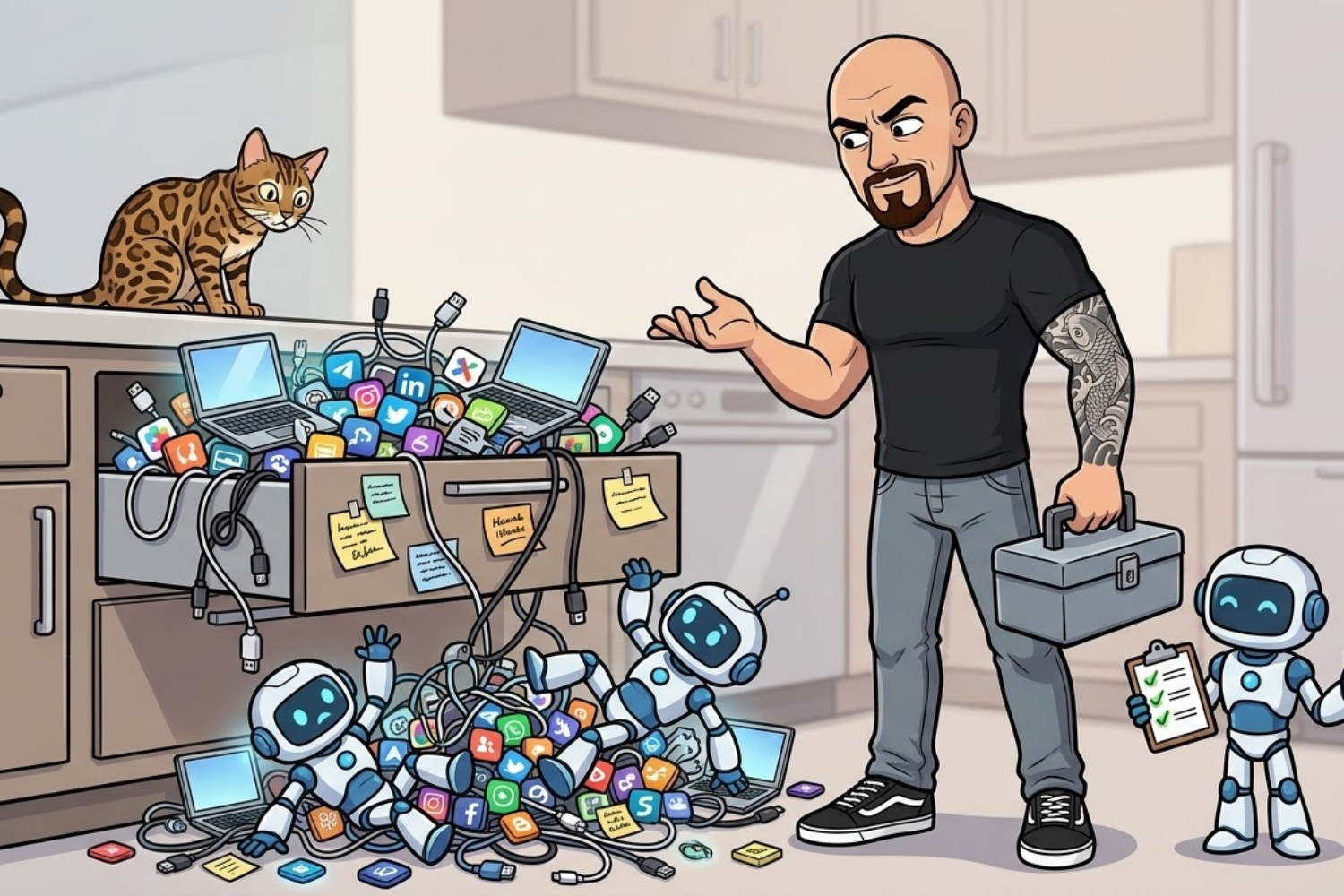
Open your company's AI tool inventory right now. Go ahead. I'll wait.
If you're like most enterprises, you'll find a mess. A ChatGPT subscription here. A writing tool there. Something someone in marketing signed up for six months ago that nobody remembers approving. According to Torii's 2026 SaaS Benchmark Report, the average enterprise now runs over 830 applications. More than 61% of them operate outside formal IT oversight. And AI-native tools are the fastest-growing category of shadow software in the stack.
That's not a strategy. That's a junk drawer.
The Party Is Over
For the past two years, the default AI strategy at most companies was "experiment with everything." Try this tool. Pilot that one. Sign up for three more. Nobody wanted to miss the wave.
Now the bill is coming due. TechCrunch surveyed 24 enterprise-focused VCs and the prediction was nearly unanimous: 2026 is the year companies stop experimenting and start picking winners. More money, fewer vendors. The experimentation budget gets redirected into the tools that actually delivered results.
One investor put it plainly. He expects budgets to increase for a narrow set of AI products that clearly deliver, and to decline sharply for everything else. A small number of vendors will capture a disproportionate share of enterprise AI spend while many others see revenue flatten or contract.
This isn't speculation. Zylo's 2026 SaaS Management Index shows that spending on AI-native applications jumped 108% year over year. Large enterprises saw a 393% surge. But app counts barely moved. Companies aren't buying more tools. They're paying more for the ones they already have, often through new AI tiers and consumption-based pricing they didn't budget for.
What SPARK6 Learned The Hard Way
We went through our own version of this at SPARK6. About a year ago, I asked our team to list every AI tool we were actively using. The number was embarrassing. We had overlapping tools for content, for code review, for project scoping, for research. Some people on the same team were paying for competing products out of different budgets.
So we did a hard audit. We mapped every tool to a specific workflow. If it didn't tie to a measurable outcome, it got cut. We went from a dozen-plus tools down to a tight stack of four or five that we actually use every day.
The result wasn't just cost savings. It was clarity. When everyone uses the same tools, you build institutional knowledge. You get better at prompting. You develop shared workflows. The tool gets smarter because your team gets smarter with it.
Scattering your attention across 15 tools means you're mediocre at all of them.
The Keep-Or-Kill Framework
If you're staring at your own AI junk drawer and wondering where to start, here's a simple framework. For every AI tool on your list, ask four questions.
Does it tie to a specific workflow? Not "productivity" in general. A named process with a named owner. If nobody can point to the workflow it supports, cut it.
Can you measure what it does? Time saved, errors reduced, revenue influenced. If you can't put a number on it within 90 days, it's a science project.
Does more than one person use it? A tool that only one person on your team uses is a personal preference, not a company investment. Consolidate around tools with team-wide adoption.
Is it redundant? Map your tools against each other. You'll almost certainly find two or three that do roughly the same thing. Pick the one your team actually uses and drop the rest.
Run this audit quarterly. The AI landscape moves fast enough that a tool that earned its spot in January might be redundant by June.
Why This Matters More Than You Think
The companies that consolidate early don't just save money. They build a compounding advantage. Deeper expertise with fewer tools. Cleaner data governance. Simpler security reviews. Faster onboarding for new hires. Every one of those benefits stacks over time.
The companies that keep the junk drawer open are paying a hidden tax. Integration headaches. Security blind spots. Fragmented workflows that nobody fully understands. And a team that's spread too thin to get genuinely good at any single tool.
This is the year the AI market bifurcates. A few platforms will capture most of the enterprise spend. The rest will fade. The question isn't whether consolidation is coming. It's whether you lead it inside your company, or it happens to you.
Clean the drawer.
Find your next edge,
Eli
Want help applying this to your product or strategy? We’re ready when you are → Let's get started.