The Quiet Pay Gap Nobody Is Talking About Yet
The Skill That Now Pays 56% More
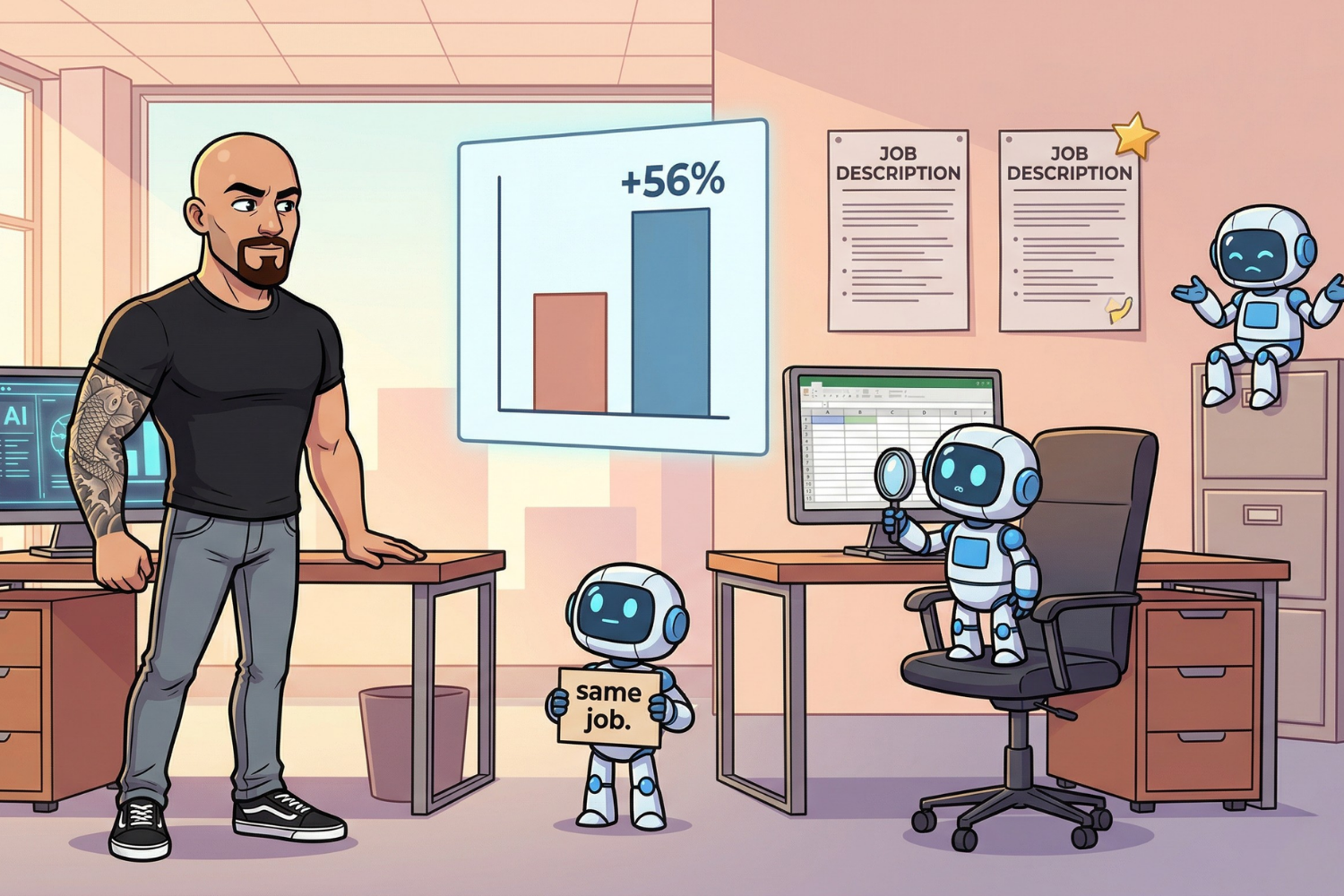
Two people. Same title. Same company. Same job description. One of them is making 56% more than the other. That's not a typo. PwC analyzed close to a billion job postings across six continents and found that workers with AI skills command a 56% wage premium over peers in identical roles without them.
A year ago that premium was 25%.
It more than doubled in twelve months.
This isn't a Silicon Valley story. The premium exists across every industry PwC studied - including ones you'd never expect, like agriculture and mining.
If you work, this affects you. If you manage people, this really affects you.
What The Market Looks Like Right Now
AI-related hiring grew 88% year-over-year in 2025. At the same time, administrative role hiring dropped 35% and entry-level hiring fell 73%. Demand for AI fluency has grown sevenfold in two years - from 1 million to 7 million workers in roles where AI skills are explicitly required.
Supply hasn't kept up.
For every three AI-capable candidates available, there are roughly ten open roles chasing them.
When demand outpaces supply by that much, prices go up fast. That's not a prediction. It already happened.
Why Most Organizations Are Getting This Wrong
Most companies are doing one of two things right now. The first is ignoring the premium entirely - running the same comp structure they had two years ago and hoping nothing breaks.
It will.
AI-fluent employees are getting recruited hard, and job postings for AI-capable talent are losing on salary before the first conversation happens.
The second is throwing premium salaries at anyone with "AI" on their resume. That creates a different problem. When the person sitting next to you finds out they're doing the same work for 56% less, you don't just have a compensation problem.
You have a culture problem.
There's a third option most organizations aren't taking seriously enough.
The Lever Nobody Is Pulling Hard Enough
Build the skills internally. Hire externally only where you genuinely have no other choice. Here's why that math works: the 56% premium reflects scarcity, not permanent market value.
Skills that are rare today become standard tomorrow. Prompt engineering briefly commanded six-figure salaries. It's now table stakes.
Companies that locked in expensive permanent comp tiers for early prompt expertise are overpaying for something that stopped being scarce.
At SPARK6, the organizations we see making real progress aren't the ones chasing the most expensive AI talent. They're the ones who mapped which AI capabilities they actually need, figured out what they could develop internally, and built a path to get there.
IKEA trained over 40,000 employees on AI literacy.
JPMorgan and Mastercard are running organization-wide enablement programs.
They're not doing this to be generous. They're doing it because it's cheaper than the alternative and harder for competitors to copy.
Three Questions Worth Asking This Week
Whether you're setting comp strategy or trying to figure out where you stand personally, these questions cut to the center of it.
Which AI skills does your organization actually need in the next 12 months - not the ones that sound good in a presentation, but the ones tied to real business outcomes?
For each gap: is this a hire or a develop? Skills you need immediately and can't build fast enough probably require external hiring. Broader AI fluency - using tools well, prompting effectively, evaluating AI outputs - can almost always be grown from within.
And if you're an individual contributor reading this: what's one AI skill you could start building this month? The premium is real. The window to get ahead of it is still open, but it's not staying open forever.
The 56% gap is the market telling you something.
The question is whether you're listening as an organization, as a manager, or as someone who wants to be on the right side of it
Want help applying this to your product or strategy? We’re ready when you are → Let's get started.