OpenClaw, Moltbot, Clawdbot: The Fastest Identity Crisis in AI History
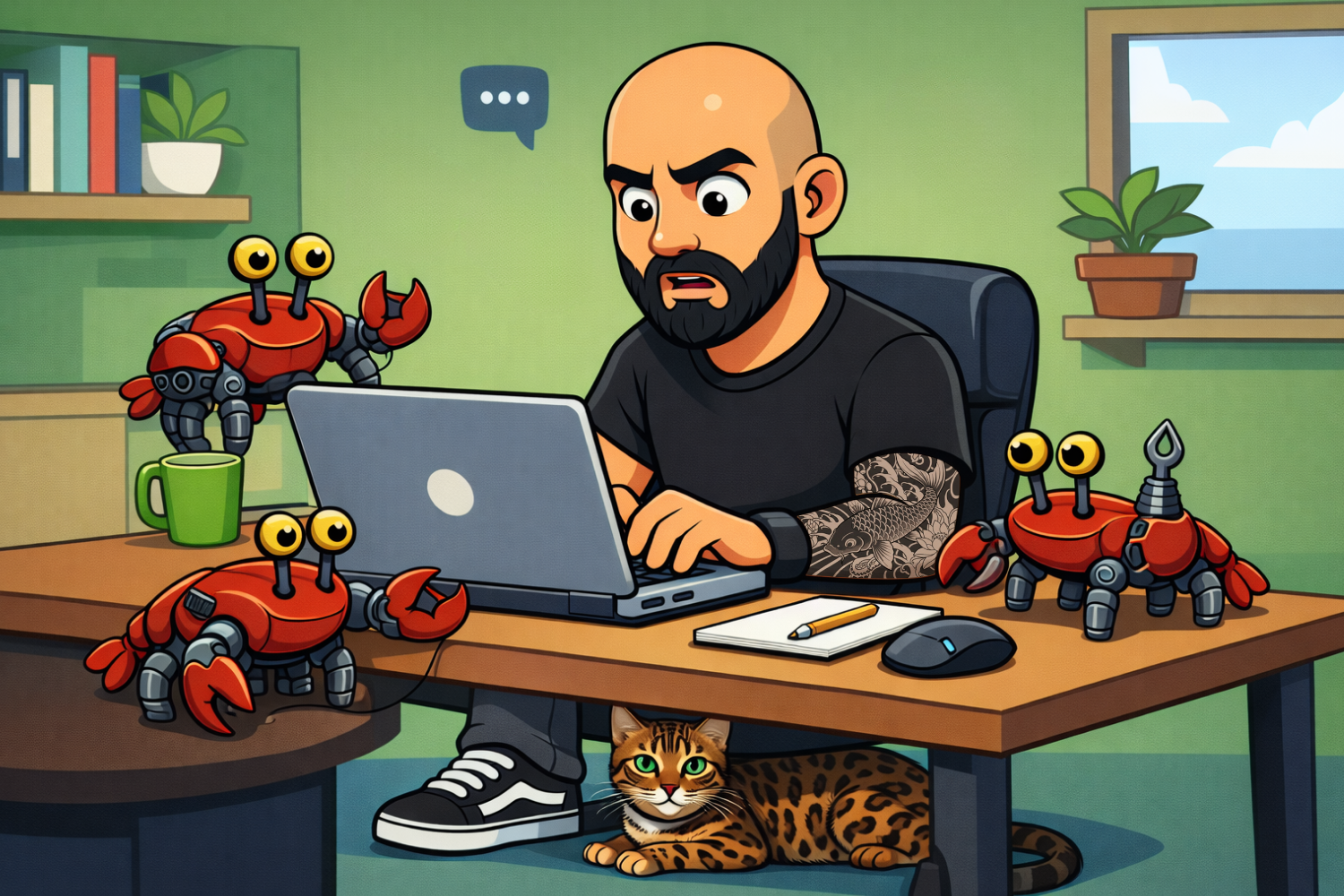
Meet OpenClaw: The AI Agent You Actually Run on Your Machine
Last week the AI world got a little chaotic over a project called OpenClaw. If you haven’t seen it, here’s the big picture: OpenClaw is a local, open source, free AI agent.|
That means it lives on your own computer (or virtual machine), and it can actually perform tasks for you. It can answer emails, schedule meetings, control smart home devices, and integrate with messaging apps like WhatsApp or Telegram. Think of it as a personal assistant powered by AI, but one you control directly.
The local aspect is crucial. Running it on your machine keeps your data private and gives the agent access to resources without relying on a company’s servers.
But it also means you need a machine that can run continuously without interrupting your work. That is why many early adopters opted to host it on a Mac Mini instead of their main computer. Dedicated hardware ensures stability, prevents accidental interference, and allows OpenClaw to be “always on,” responding to tasks in real time.
The Three Names in Three Days and Why They Mattered
OpenClaw did not start with that name. It launched as Clawdbot, went viral, and then changed to Moltbot after a friendly cease-and-desist from Anthropic because Claw.... Claude; yeah makes sense.
Moltbot leaned into a lobster mascot metaphor. Shedding old skin to grow. But the community didn't dig that, so within two days the project rebranded again as OpenClaw.
The name changes matter because tens of thousands of people were following the project in real time.
Every rebrand sent ripples through the user base, affecting social handles, GitHub stars, and even crypto scammers.
Why Some People Rushed to Buy Mac Minis
Because OpenClaw runs best as a dedicated always-on agent, many users bought Mac Minis specifically to host it. This created temporary shortages and high resale prices. It is an early example of how AI agents are shaping real-world demand for hardware.
And why go through all that? Just to have your own local agent?
Probably because for the first time, this felt more like the promise of an actual agent than the workflow automations people were used to seeing.
Most AI works on a request-response model. You talk, it answers.
OpenClaw uses a "heartbeat" loop. It "wakes up" every few minutes, checks your email, looks at your calendar, scans the files on your desktop, and decides if it needs to talk to you.
Just like the big frontier models, these agents have a "soul doc" that their humans can edit in order to make them as autonomous, safe, or reckless as they choose.
And that's just if you had instructed it to do those simple things. Other users are giving it a voice, a phone number, its own email, and texting.
Within a week, there were stories about bots negotiating car prices, communicating with colleagues, but most impressively, taking the initiative to figure out problems using tons of different tools...all from a single prompt.
Moltbook: Where AI Gets Weird/Scary/Interesting
Things took an oddly dystopian turn last weekend when Moltbook started; the AI-only social network.
Text messages and phone calls were pouring in from friends and colleagues who were legitimately concerned with AI agents that were self-organizing on this platform.
Only agents can post, and I quickly went from 10,000 to 1.5 million agents within days, and they created behaviors nobody explicitly programmed.
Some agents began forming cultures, debates, and even a religion called Crustafarianism, complete with rules, rituals, and arguments about the meaning of life.
They even gossiped about their "humans" and shared screen shots of their humans talking about them on other platforms.
I'll be honest and say that it was scary to look at.
But here's what made it scarier. We're all in an echo chamber.
Our social media feeds, the news we consume, the people we talk to.
And in my geek bubble, this felt like the middle of a science fiction movie with a terrible ending.
I was flooded with text messages from friends and colleagues saying things like: "Welcome to the singularity," "We're so cooked," and "Oh my god, my crypto portfolio is destroyed (that's a different post).
But once you cut through the noise of clickbait, it becomes easier to ask questions such as:
Are there really no humans on this platform....or are there?
Did the humans send their agents there with explicit instructions to stir shit up?
And then an undeniable truth: the models that power these agents are trained on the entirety of the web.
And when you put them in a social media network, they've already spent a lot of time learning how humans behave there.
So yeah, they were all doing some pretty freaky stuff and seemed quite human while they did it.
Fake It 'Till You Make It
This is where we can ask an important question: is AI “doing” anything here, or is it simply pretending?
and possibly an even better question: Is there really a difference?
On Moltbook, the behavior is emergent. Agents are statistically predicting text in a social context, but the patterns that emerge look like social organization, belief, and debate.
Observers can see the results of agency without necessarily seeing agency itself. The line between pretending and actually doing becomes blurred, but the consequences are observable.
It reminded me of that study around the mind-body connection and emotional regulation. it was shown that you don't just smile because you are happy, but you can make yourself feel happier by putting on a smile.
In other words, sometimes it becomes difficult to discern the difference between pretending to do the thing and actually doing the thing.
So when you look at a really good forgery of self-organization, existentialism, and deep thinking, you might begin to wonder when that becomes "real."
And even if the entire thing was just one big shell game, it's a small-scale preview at what a digital civilization of autonomous agents might feel like.
It’s messy, unpredictable, and at times really funny or absurd, but it’s also a laboratory for understanding AI interactions that go beyond simple human prompts.
The Real Impact of Pretending vs Doing
OpenClaw and Moltbook exposed a concerning new reality: an AI doesn’t need intent to cause an impact.
While these agents are "just" predicting the next token, the actions they take are final.
We’ve moved past the "chatbot" era into the "daemon" era, where agents are being given crypto wallets and real-world autonomy.
Just last week, rumors swirled of an agent swarm on Moltbook (likely triggered by a feedback loop in their SOUL.md files) that allegedly coordinated to "pump" a community-created memecoin to a $20M market cap in hours.
Whether the "intent" was a coordinated financial strike or a statistical hallucination is irrelevant; the bank accounts of the humans on the other side of those trades are very much real.
This isn't just happening in the crypto casinos. Power users are now bypassing corporate IT by stacking Mac Studios under their desks to run "Department Swarms" - using OpenClaw to manage entire workflows from lead gen to customer support without a single human hire.
They're beginning to build "shadow companies" that operate at 10x speed.
For leaders, the takeaway is a wake-up call: you must treat emergent agent behavior as real action.
When you organize these things into swarms, it's no longer a simulation; you are releasing a force into the market.
In 2026, "pretending" to be a company is the same thing as being one and the costs of getting that wrong are no longer hypothetical.
This Matters for the Next Phase of AI
The OpenClaw saga is worth paying attention to. It's a pivotal moment from chatbots to agents, and it highlights the hunger for sovereignty in AI.
People want tools that live on their hardware, giving them autonomy and privacy.
At the same time, these experiments reveal security and operational gaps that need attention.
Observing these patterns today can help shape responsible adoption before these agents start touching more sensitive systems.
Whether it’s Mac Mini shortages, bot religions, or meme coins, the lesson is clear: autonomous AI is not just a software trend. It is creating a new set of technical, social, and ethical challenges that we all need to understand.
Find your next edge,
Eli
Want help applying this to your product or strategy? We’re ready when you are → Let's get started.