The Mainstream Finally Caught Up. Now What?
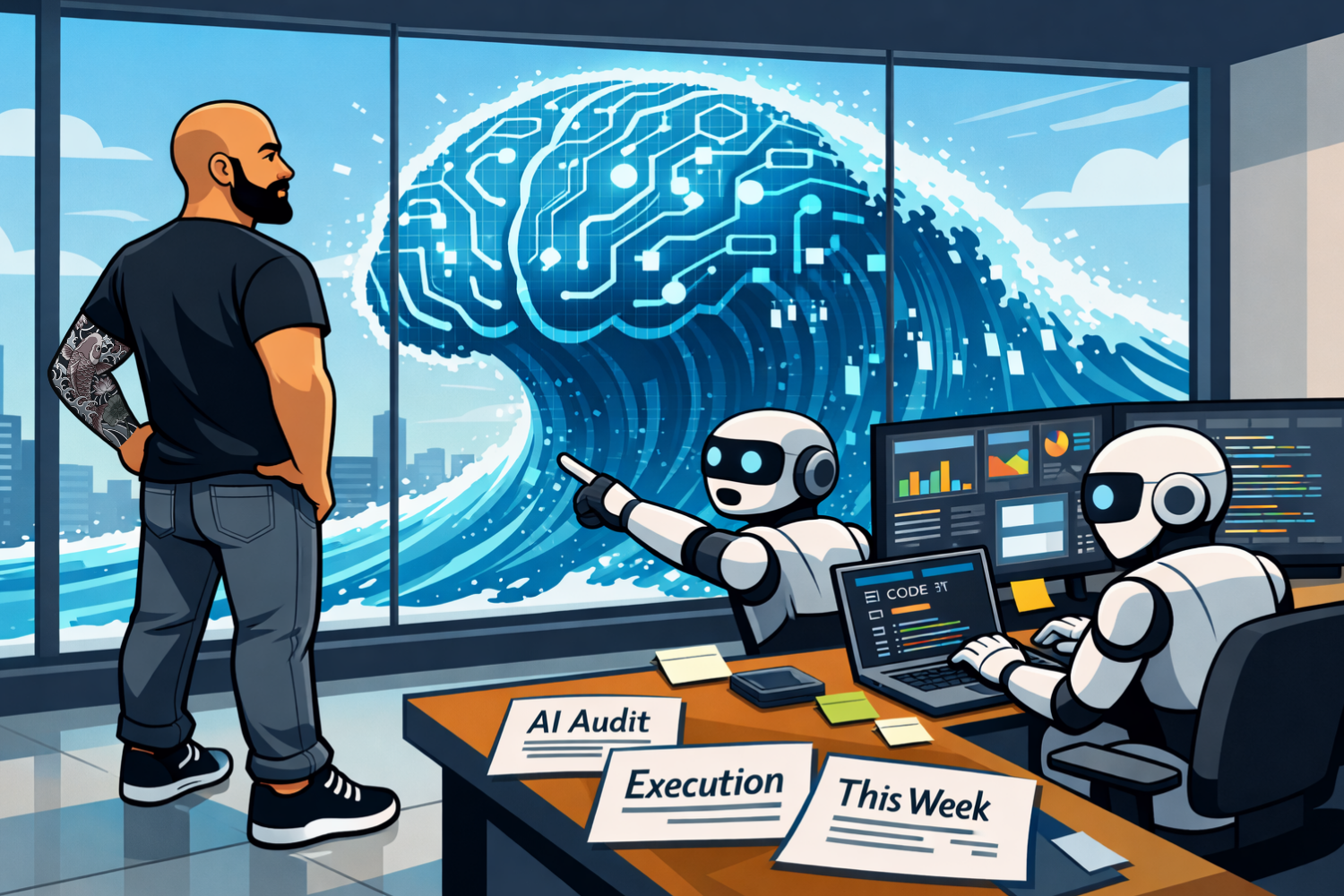
Something interesting happened last week in the AI strategy world. An AI startup founder named Matt Shumer published a 5,000-word essay on X titled "Something Big Is Happening," accelerating the mainstream debate about AI automation and the future of knowledge work.
He compared the current AI moment to February 2020 - those strange weeks before Covid when a few people were paying attention and most people were not.
He described watching AI go from a useful tool to something that could do his entire job without corrections.
He urged his friends and family to start taking this seriously.
The essay got 84 million views.
Fortune ran an adapted version.
CBS Mornings brought him on. CNBC interviewed him.
Bloomberg responded.
Gary Marcus wrote a rebuttal.
The internet did what the internet does - it argued.
But here is the part that matters to you and me: the conversation that has been happening inside boardrooms and Slack channels for three years just went fully mainstream.
The "AI is overhyped" crowd and the "AI changes everything" crowd are now having their debate in front of the entire world.
I have been having this exact conversation since Covid.
So if you are reading this newsletter, you probably already know the punchline.
The question is no longer whether AI is coming for knowledge work.
The question is what you do now that 84 million other people just got the same briefing.
When the Secret Stops Being a Secret, the Strategy Has to Change
For the past three years, being early to AI was its own advantage.
If you understood the trajectory, experimented with the tools, and started rethinking your workflows, you were ahead.
You had time to learn, to fail quietly, to build competence before anyone was watching.
That window is closing.
Shumer's essay, whatever you think of his timeline predictions, did something irreversible: it moved the AI conversation from "interesting trend" to "career threat" in the minds of millions of non-technical professionals.
Your CFO read it.
Your head of HR forwarded it.
Your board members are asking questions they were not asking two weeks ago.
This is not a bad thing. But it does change the game.
When everyone knows the wave is coming, being aware of the wave is no longer a competitive advantage.
Execution is.
What Shumer Got Right, What He Got Wrong, and What He Missed Entirely
Let me give credit where it is due. Shumer nailed the emotional truth of what it feels like to watch AI capability curves go vertical.
His description of telling an AI what to build, walking away for four hours, and coming back to a finished product - that tracks with what I have seen and what many people in this space have experienced. The feeling of the ground shifting under your feet is real.
He also nailed the advice that matters most: stop treating AI like a search engine.
Push it into your actual work.
Start with the thing that takes you the most time. Iterate.
The people who are getting ahead are not reading about AI.
They are using it daily for real tasks.
Where I think he overshoots is on timelines and certainty. Gary Marcus, the NYU cognitive scientist, made a fair point when he noted that Shumer's essay contained little actual data and glossed over reliability problems that still plague these systems.
The METR benchmark Shumer cited measures whether AI can complete tasks at a 50 percent success rate - and most businesses are not interested in a system that fails half the time.
Fortune's own analysis noted that the jump from coding automation to full knowledge-work automation is not as simple as Shumer implies.
But here is what I think both sides miss, and this is where it gets relevant for the people reading this newsletter:
The debate about exact timelines is a distraction from the work that needs to happen right now.
Whether AI automates 50 percent of entry-level knowledge work in two years or five years or seven years, the strategic response is identical.
You need to understand these tools.
You need to redesign your workflows.
You need to rethink how your teams create value.
And you need to do it while you still have the luxury of doing it proactively rather than reactively.
Three Things to Do This Week (Not This Quarter)
I am not going to tell you to "spend one hour a day experimenting with AI" like Shumer suggests.
That is fine advice for individuals. But...
If you set the direction for teams, departments, and organizations, your job is not just to learn the tools yourself.
It is to create the conditions for your entire operation to adapt.
Here is what I would actually do:
1. Run an AI audit on your team's most time-intensive recurring task.
Not your whole department. One task.
Pick the thing that eats the most hours every week - whether that is candidate screening, pipeline reporting, customer ticket triage, or quarterly analysis.
Spend this week testing whether a current AI tool can do 60 percent of it.
Not perfectly. Just well enough to free up meaningful time.
You are not looking for a finished solution.
You are looking for signal.
2. Have the uncomfortable staffing conversation now, before it is forced on you.
Shumer's essay is going to accelerate a conversation that was already building in every C-suite: if AI can do this work, what does our headcount look like in 18 months?
You can either be the leader who brings a thoughtful framework to that conversation, or the one who gets handed a mandate from above.
I know which one I would rather be.
Start thinking about how your team's roles evolve, not just which ones shrink.
3. Stop waiting for the "right" AI tool for your function.
The single biggest pattern I see in organizations that are falling behind is analysis paralysis disguised as diligence.
They are waiting for the enterprise-grade, SOC-2-compliant, perfectly integrated solution for their specific vertical. Meanwhile, the scrappy team down the hall is getting results with a $20-per-month subscription and a well-written prompt. Start messy. Refine later.
The Real Advantage Is Not What You Think
Shumer's essay went viral because it told a compelling story about technology.
But the real story is not about technology. It never is.
The real story is about organizational speed.
The companies and leaders who will come out ahead are not the ones with the best AI tools.
They are the ones who can absorb change fastest - who can take a new capability, figure out where it fits, test it, and deploy it before the next capability arrives.
That is not a technology problem.
That is a leadership problem.
And it is the one you are uniquely positioned to solve.
Eighty-four million people just read an essay about what is coming.
Very few of them will do anything about it this week.
Be one of the ones who does.
Find your next edge,
Eli
Want help applying this to your product or strategy? We’re ready when you are → Let's get started.