The Burnout Nobody Is Talking About in the AI Era
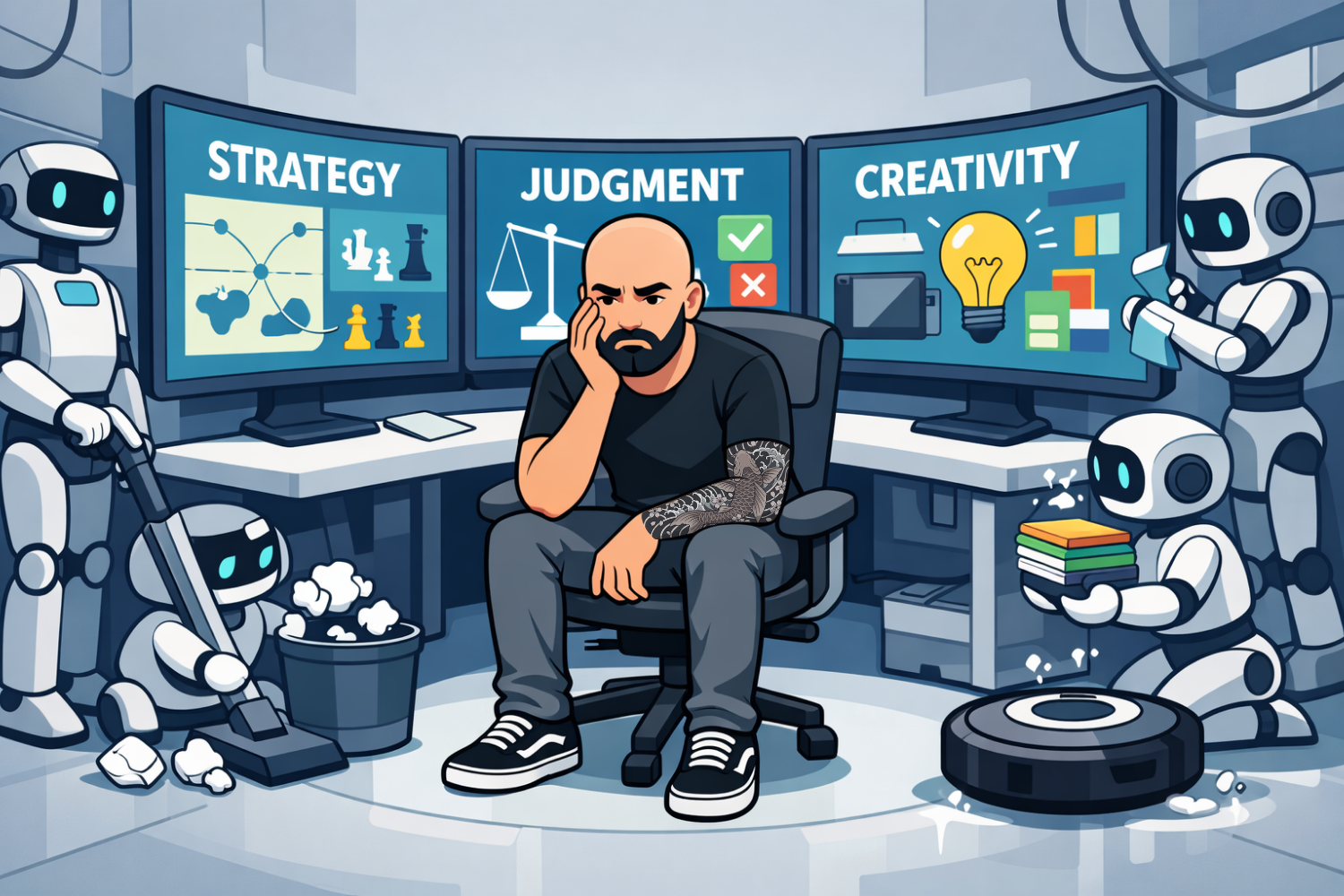
For the last year, leaders have been sold a simple promise about AI:
Eliminate low-value work.
Focus on your zone of genius.
Get time back.
All true. And it's happening at a rate that will reach a critical mass in 2026.
And yet, something strange is happening underneath the surface.
As AI removes the repetitive, low-cognitive-load tasks from our days, many high performers are reporting a different problem: they’re more focused than ever...and more exhausted than ever.
Not because they’re doing too much work.
But because they’re doing too much of the high-intensity work.
This is the burnout nobody is talking about. Yet.
AI is compressing time more and more. But it's also compressing recovery.
And if you don’t redesign your day for that reality, your zone of genius will quietly fry you.
Why Removing “Brainless Work” Isn’t an Unambiguous Win
We’ve been taught to treat repetitive work as waste.
Light admin.
Inbox cleanup.
Operational busywork.
The stuff you never brag about.
But here’s the harsh truth:
Not all low-value work was useless.
Some of it was doing a different job entirely.
It was:
- A cognitive palate cleanser
- A pressure-release valve between hard decisions
- A way to stay productive without staying razor focusued
Think about it this way.
After a long day of intense parenting, no mom or dad relaxes by reading white papers. They scroll. They fold laundry. They do something mentally light.
Those activities aren’t optimized for the greatest output or leverage.
They’re stabilizing.
AI is now deleting that category of work from our days without replacing the function it served.
What’s left is a nonstop gauntlet of:
- Strategy
- Creativity
- Judgment
- Emotional labor
- Decision-making
In other words...
A cognitive ultramarathon with no aid stations.
A Personal Observation From Inside the Machine
This came up recently on our podcast, and it hit a nerve.
As teams automate more, the “easy” parts of the day disappear. Meetings get sharper. Outputs get tighter. Decisions get heavier.
On paper, that sounds like progress.
In practice, it creates a subtle trap: you spend the entire day operating at the top of your cognitive range with no built-in cooldown.
What used to be accidental recovery is gone.
Which means recovery now has to be designed.
The Framework: Cognitive Load Balancing in an AI-Accelerated World
Here’s the playbook I’m seeing work for leaders who want the upside of AI without the burnout tax.
1. Recognize That Your Zone of Genius Has a Daily Ceiling
Your zone of genius is powerful, but it is not infinite.
It has:
- A daily capacity
- A recovery cost
- Diminishing returns after a certain number of hours
AI doesn’t remove that ceiling; it just helps you hit it faster.
The mistake most high performers will make is filling reclaimed time with more high-stakes thinking.
The smarter move is capping it.
As a rule of thumb:
3–5 hours a day of true “genius work” is sustainable.
Beyond that, quality drops even if effort doesn’t.
2. Replace Accidental Recovery With Designed Recovery
In the old world, recovery happened by accident.
Cleaned up docs.
You answered emails.
Light operational work between meetings.
AI is deleting that layer.
So you need to intentionally add back activities that meet three criteria:
- No real consequences
- Low cognitive demand
- No meaningful decisions
Examples that actually work:
- Walking meetings with no agenda
- Low-stakes writing that will never be sent
- Organizing notes without synthesizing them
- Reviewing information without being responsible for the outcome
- Manual, physical tasks (yes, literally doing something with your hands)
The test is simple: If you could do it while tired and not make things worse, it qualifies.
3. Stop Treating Every Freed Minute as a Productivity Opportunity
This is the hardest shift for high achievers.
AI creates time. Our instinct is to monetize it.
But cognitive capacity doesn't have a direct exchange rate for cash.
It’s a nervous system resource, not a bank account.
Every minute you save does not need to be reinvested into thinking harder.
Sometimes the highest ROI move is protecting the system that does the thinking.
Leaders who last in this next phase will move away from extreme optimization,
and instead be the most regulated.
4. Redesign the Day Around Cognitive Transitions, Not Tasks
Most calendars optimize for meetings.
Very few optimize for mental transitions.
A more resilient AI-era schedule looks like this:
- High-cognitive blocks early and tightly scoped
- Low-load cooldown immediately after
- Physical or sensory resets between contexts
- End-of-day work that is intentionally unimportant
If your day ends with nothing but judgment calls and open loops, you’re borrowing energy from tomorrow.
AI doesn’t fix that, but design does.
The Big Idea to Take With You
AI maturity is far more than just knowing what to automate.
The real leaders will begin focusing on knowing what to preserve.
If you remove every low-load activity from your day, you don’t become superhuman.
You become brittle.
Your zone of genius needs recovery just like your muscles do.
And in an AI-accelerated world, that recovery won’t happen unless you build it on purpose.
And at the end of the day what might have looked like laziness....
will be reframed as real leadership.
Find your next edge,
Eli
Want help applying this to your product or strategy? We’re ready when you are → Let's get started.